Great reception last night at the Alchemical Vessels benefit! Wall-to-wall with artists and guests and curators. The video below shares some of the artists' stories, including my interview about process and goals in my work.
Alchemical Vessels Reception at Joan Hisaoka Healing Arts Gallery
4/5/2014
Great reception last night at the Alchemical Vessels benefit! Wall-to-wall with artists and guests and curators. The video below shares some of the artists' stories, including my interview about process and goals in my work.
Alchemical Vessels Benefit 2014
3/14/2014
- Special Benefit (by contribution only) - Friday, May 2, doors open at 7pm
The Alchemical Vessels Exhibition will be open at the Joan Hisaoka Healing Arts Gallery from April 4th through May 16th, 2014. There will be an opening reception on Friday, April 4th from 7-9pm.
Alchemical Vessels: April 4 through May 16, 2014
- Opening Reception - Friday, April 4, 7-9pm- Special Benefit (by contribution only) - Friday, May 2, doors open at 7pm
Smith Center for Healing and the Arts and the Joan Hisaoka Healing Arts Gallery are proud to announce the return of Alchemical Vessels, Smith Center's 2nd Annual Benefit and Exhibition. Learn more and support.
This is a great event that brings together curators, artists, and art lovers to support a wonderful resource in the Metro DC community... that in turn supports healing through the arts.
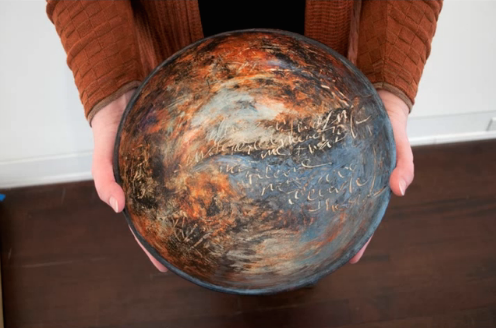
At right is my work-in-progress for the event. See the Facbeook Event for more alchemical vessels in process from this year's artists.
Alchemical Vessels brings together 125 local artists and 20 prominent curators
for a community dialogue on healing and transformation through the
arts. Each artist will transform a simple ceramic bowl by means of his
or her own personal aesthetic and medium, drawing inspiration from the
bowl as a place of holding, community, sacred space, and the alchemical
vessel.
The ceramic bowl was selected as the fundamental element of the exhibition to symbolize creating a space where healing can take place—an idea at the heart of Smith Center's work and mission. Metaphorically speaking, Smith Center—the space and the work we do within our walls—resembles an alchemical vessel. People bring their everyday burdens, fears, and pains to us, and in this place of holding, we help transform those toxic elements into hope, light, wisdom and strength.
Artists: Eames
Armstrong, Sardar Aziz, Karen Baer, Beth Baldwin, Michele Banks, Joseph
Barbaccia, Carolyn Becker, Jessica Beels, Joan Belmar, Lori Anne
Boocks, Anne Bouie, Amy Braden, Julia Brown, Karen O. Brown, Larry
Brown, Amanda Burnham, Lenny Campello, Shanthi Chandrasekar, Mei Mei
Chang, Peter Charles, Asma Chaudhary, Travis Childers, Eunmee Chung,
Wesley Clark, Chanel Compton, Michael Corigliano, Sheila Crider, Candy
Cummings, Anna U. Davis, Rosetta DeBerardinis, Tamara De Silva, Elsabe
Dixon, Joel D’Orazio, David D’Orio, Chelsea S. Dobert-Kehn, Thomas
Drymon, Nekisha Durrett, Victor Ekpuk, Laura Elkins, Dana Ellyn, Erica
Benay Fallin, Felisa Federman, Jeremy Flick, Suzi Fox, Barbara Frank,
Nancy Frankel, Shaunté Gates, Dawn Gavin, Bita Ghavami, Aziza Claudia
Gibson-Hunter, Melissa Glasser, Janis Goodman, Pat Goslee, Sherill Anne
Gross, John Grunwell, Nelson Gutierrez, Kristen Hayes, Eve Hennessa,
Sean Hennessey, Linda Hesh, Matt Hollis, Leslie Holt, Jessica Hopkins,
Karen Hubacher, Monica Jahan Bose, Barbara Johnson, Wayson R. Jones,
J’Nell Jordan, Mila Kagan, Sumita Kim, Joan Konkel, Yar Koporulin, Kate
Kretz, Randall Lear, Yue Li, Nathan Loda, Armando Lopez-Bircann, Laurel
Lukaszewski, James Mahoney, J.J. McCracken, Donald McCray, Jayme
Mclellen, Tendani Mpulubusi El, Komelia Okim, Amie Oliver, Luis Peralta,
Michael Platt, Maryanne Pollock, Lynn Putney, Maria-Lana Queen, Beverly
Ress, Kim Reyes, Glenn Richardson, Marie Ringwald, Amber
Robles-Gordon, Pam Rogers, Lisa Rosenstein, Nicole Salimbene, Samantha
Sethi, Matt Sesow, Amy Sherald, Shahin Shikhaliyev, Ellen Sinel, Casey
Snyder, Susan Stacks, Dafna Steinberg, Jennifer Strunge, Lynn Sures,
Lynn Sylvester, Ira Tattelman, Christine Buckton Tilman, Erwin Timmers,
Ben Tolman, Novie Trump, Shinji Turner-Yamamoto, Laurie Tylec, Michael
Verdon, Jodi Walsh, Jenny Walton, Ellyn Weiss, Stephanie Williams,
Audrey Wilson, Sharon Wolpoff, & Carmen C. Wong.
Curators: Peggy Cooper Cafritz, Educator, Philanthropist & Founder of D.C.'s Duke Ellington School for the Arts | Jarvis DuBois, Independent Curator & Principal at J. DuBois Arts | Monica Jahan Bose, Artist & Activist | Anne L'Ecuyer, Arts Management Faculty at American University | Camille Mosley-Pasley, Photographer & Principal at Pasley Place Photography | B.G. Muhn, Professor of Art, Georgetown University | Michael O'Sullivan, Art Critic for The Washington Post | Dr. Frederick P. Ognibene, M.D., NIH Physician, Fine Art Collector & Past Board Chair, Washington Project for the Arts | Michael Platt, Artist & Professor at Howard University | Jennifer Riddell, Writer & Interpretive Projects Manager at the National Gallery of Art | Adah Rose, Principal at Adah Rose Gallery | Laura Roulet, Independent Curator & Writer | Molly Ruppert, Artist & Gallery Director at the Warehouse Theater | Terry Scott, Cultural Organizer & Independent Curator | Judy J. Sherman, Art Consultant & Principal at j. fine art | Thomas Stanley, Professor at George Mason University | Nuzhat Sultan, Independent Curator | Tim Tate, Artist & Co-Director of Washington Glass School | R.L. Tillman, Artist, Teacher & Curator | Dolly Vehlow, Fine Art Collector & Principal at Gallery O on H
New Work: Rain in Suzhou
2/24/2014
I don't think it rained at all during my short visit to China almost 20 years ago, but there was a lot of water--lakes and canals. This painting is more about what things look like after the rain, and on a personal note, about deciding to try to have a child. 40 x 30" in the usual acrylic and charcoal on canvas.
![]() | |
| Rain in Suzhou |
New Series: Amulets
2/20/2014
Lately I've been interested in old decaying objects that have been cast off. I want to give them new life. They've been through a lot--discarded, exposed to the elements, forgotten. They've survived, been found, and given a new purpose. I want to revere them as symbols of strength.
These new pieces are 6 x 6 inches on wood panel with acrylic and charcoal.
![]() | |
| Amulet No. 1 (for courage) |
![]() |
| Amulet No. 2 (for luck) |
Book: Inside the Painter's Studio
2/15/2014
I'm so loving this 2009 book, Inside the Painter's Studio, by Joe Fig. The interview format works great and it's fascinating to learn about process, sense of space, and career trajectories of artists I'm really familiar with and others not so much. April Gornik has shared my favorite insights so far:
"I think we are kind of on the brink of visual illiteracy even though we have so much visual information culturally. You know, the activity of making a painting, the almost architectural building of a painting where you work into it and into it, those critical 1/8-inch decisions that go on as you're painting, and all the time you put into it, all that still lives in the work after it's done. In a good painting, all that reads back to the viewer. So you're looking at something that's stocked with this huge amount of time passed--but held. You know a good painting holds all that. And all the great old paintings are like that."
And on size and scale: "For a long time people would ask me why I make my paintings the size that they are. It really has a lot to do with wanting to feel that they are like the size of my body. You can sort of walk into them--a very experiential kind of experience.... this is the size of my mind. This is like my head. This is how big my head is. I inhabit this."
The author also does these amazing miniatures of the studios he's visited, little micro-worlds that capture the expansive conversations he has documented. This book is a must-read if you're as fascinated as I am about what happens between head and canvas in the studio setting.
New Painting: Vermilion Summer (Dreaming of Hangzhou)
2/13/2014
Cold winters make me want to paint about spring and summer. I just sent out my bimonthly e-newsletter with the back story for this new piece. I invite you to sign up to get these little histories delivered straight to your inbox every other month or so. Here's Vermilion Summer and why I painted it...
Two decades ago I had the good fortune to visit southeastern China for three weeks. Wang Zhongwei, a painter from Zhejiang province, became a great friend of mine in the early 90s when he was an exchange professor at Old Dominion University. He convinced me to see for myself the place that inspired the calligraphy he'd taught me. It was a magical time filled with bright scarlet silks in outdoor market stalls, the earthy-metallic smell of cinnabar chop ink, and dazzling Yueju opera costumes worn by a female-only cast.
The new painting above is a tribute to that unforgettable trip. It’s 48 x 48 inches and my usual acrylic and charcoal on canvas. Stay warm and safe out there!
An Interview with Artist Clare Winslow
1/19/14
A: Using embroidery came out of my desire to add more surface texture to screenprints. I've been sewing since I was 12, but only recently figured out how I could incorporate it into my fine art work. Having tried various techniques to add texture to paper prints, I decided to try fabric, combining my love of sewing and screenprinting in a way that works graphically, makes the piece tactile, and reminds me of home and things handmade. It's a wonderful counterbalance to my computer-based work.
Twitter is widening my world of artists locally and beyond. Each time someone follows me, I take the time to visit their website and see what they're up to. That's how I came to learn about the wonderful prints Maryland artist Clare Winslow is creating. And since I'm a fan of threading rope, string, and wire through paintings, I was particularly taken with how she incorporates thread in her screenprints.
Q: I love how you're using embroidery in your work. Why did you decide to use it, and what challenges does it present, if any? Do you add thread by hand or by machine?
A: Using embroidery came out of my desire to add more surface texture to screenprints. I've been sewing since I was 12, but only recently figured out how I could incorporate it into my fine art work. Having tried various techniques to add texture to paper prints, I decided to try fabric, combining my love of sewing and screenprinting in a way that works graphically, makes the piece tactile, and reminds me of home and things handmade. It's a wonderful counterbalance to my computer-based work.
![]() |
| Migration 2 |
All
the sewing is done by hand. Machine sewing looks too mechanical to me for this
purpose. Sewing through paper was challenging because of the paper's stiffness,
but the thread and the ink combine well, I think. And silk embroidery thread
picks up the light better than the regular type.
Q: What's the one thing you'd like people who aren't familiar with you/your work to know about you?
A: I'm also a trained graphic designer and create web sites and promotional material, often for artists. My graphic design sensibility often shows up in the work, especially the pieces incorporating symbols. In a previous life, I taught English in Japan for two years, and Japanese prints are a strong influence, particularly in their use of color.
![]() |
| Zone of Silence |
Q: What's your favorite piece from the past year and why?
A: Zone
of Silence, which is a piece in a series loosely related to bird migration.
Zone of Silence refers to an acoustic shadow zone, an area where so-called
"infrasounds" or pressure waves that travel through the atmosphere,
are absent. When passing through these places, pigeons are not able to find
their destination.
Q: Do you create intuitively, with a hardcore plan, or somewhere in between?
A: I start with a loose plan, then go where the work takes me, improvising along the way. In the Zone of Silence piece, the printing part was somewhat predefined, but the sewing was spontaneous. But then again, printmaking always has a degree of surprise, so the final result is often different from what you planned.
Q: Who is your biggest influence and why?
A: That's
a tough one, because I admire the work of so many artists, both historical and
contemporary. In terms of work ethic, I'd have to say I appreciate my family
members who are artists: my grandmother, Marcella Winslow, a Washington DC
painter from the 1940s to the 1980s, my father, John Winslow, another veteran DC
painter, and my mother, also an artist, who taught me to sew!
![]() |
| Zodiac |
Q: What do you feel is the best thing about being an artist in the DC area? What
do you wish DC could do better?
A: Besides
the wonderful museums and galleries, there's so much good local art in DC. I
would like to see more attention paid to that fact in the Washington Post, as
well as an increase in visual art coverage in all the local publications. I
would also like to see more recognition of printmaking in general, as I think
that it is an underrated art form, and the DC printmaking scene is vibrant!
Thanks, Clare, for sharing your background, process, and work here! Clare has a large portfolio online as well as originals and reproductions available at Saatchi Online, Etsy, Fine Art America, and Society6. Check out her wonderful work!
Subscribe to:
Posts (Atom)


